
This repository contains software to load and start the Linux-Kernel on the Behringer X32, some userland tools and x32ctrl - the main logic of our custom firmware. This audio-mixing-console uses a Freescale/NXP i.MX253 Microcontroller with an ARM926EJ-S core that supports booting Linux.

Currently the Linux Kernel is running in Version 6.18 (LTS) with busybox (the picture is older, shows Kernel 6.12):

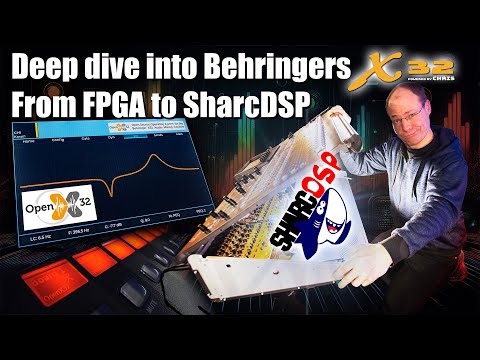
More information in the related two Youtube-Videos:

A Youtube Short of the complete OpenX32 Alpha running on a X32 Rack:

Next to the underlaying Linux we are working on the audio-processing as well.
The Linux has control over most parts of the i.M253 main-controller:
- Linux-Kernel in Version 6.18 (LTS) starts to shell using 800x480 display framebuffer
- init-script for setting up the operating system
- MIDI-Input and -output is used as an additional serial-port-terminal (see pinout down below)
- Support of 100MBit ethernet network-support with DHCP
- Support of internal Realtime-Clock
- Support of USB-Host interface (HID-Keyboard, HID-Mouse, Mass-Storage-Devices, Joystick, Soundcard, etc.)
- Support of internal SD-Card to read MAC-Address and the general configuration
Several audio-functions are already supported:
- Configuration of FPGA (Xilinx Spartan 3A or Lattice ECP5) via internal SPI-interface
- Support of both AnalogDevices DSPs (ADSP-21371 SHARC DSPs) via internal SPI-interface
- Support of 1:1-routing for the available 112 inputs (32x XLR, 8x AUX, 32x Card, 40x DSP) to 112 outputs (16x XLR, 16x UltraNet, 8x AUX, 32x Card, 40x DSP)
- Support of UltraNet-Output
- Support of internal 8-channel analog input- and output-cards including headamp- and phantom-power-control
- Support of internal 8-channel AUX-AD/DA-Converter (CS42438 on older revisions, M8000 on newer revisions)
- Noisegate, 4-band EQ and compressor per channel is already working within the main-DSP
The hardware-surface is working, too:
- Support of booting from SD-Card and via USB using the original DCP-Bootloader
- Control of X32 surface (faders, buttons, LEDs, encoders) through x32ctrl-software
So the most important things (audio in/out, control-surface, display) are working already and more things are on the ToDo-list:
- In-Progress: Boot from barebox as a successor of U-Boot (U-Boot has ended the support of i.MX25 since a couple of years; barebox already boots OpenX32 from development sd-cards)
- Planned: Support of AES50
- Planned: Implement advanced audio-algorithms in DSP2
- Planned: ALSA Soundcard with I2S to main-FPGA (DeviceTree option "simple-audio-card" via SSI1 and AUDMUX is not initializing)
- Planned: GPIO support via libgpiod (at the moment libgpiod is not working and has no control over /dev/gpiochipX)
LVGL v9.3.0 is running on the X32 with a good performance (30 fps). So this will be a basis for this open-source Operating System:


I want to learn things about embedded systems and how they work. The X32 is a very powerful playground with lots of different controllers, nice faders and displays. So that's the only reason why I'm doing this :-)
Yes, here: https://discourse.openmixerproject.de
Checkout the most recent release from https://github.com/OpenMixerProject/OpenX32/releases and follow the instructions there. You only have to copy a couple of files onto an USB-thumbdrive and boot into Linux :)
This system uses the most recent versions of the tools I could find: the bootloader u-Boot is used in Version 2020.10 as this is the last U-Boot supporting the i.MX25. Up to now Linux has still support for the i.MX25 and I selected v6.12, the most recent LTS-kernel.
So the repository uses other GitHub-repositories as submodules (u-Boot, Linux and pyATK). Please use the following command to checkout the main-repo together with submodules. To minimze the download-size and -time, we will clone the submodules separately:
git clone --depth 1 https://github.com/xn--nding-jua/OpenX32.git
cd openx32
./gitinitsubmodules.sh
Next to the sourcecode, your system needs to be setup correctly to compile the whole system: setup your debian-based system by calling:
./setup.sh
This script will install several dependencies to compile u-boot and the linux-kernel. After installing the packets, it will patch pyATK to run with recent versions of Python 3.11 and newer. It will also configure pyATK in a virtual python-environment.
Compile u-boot, Linux and busbox by calling the script ./compile_all.sh and upload the new operating system into the RAM by calling the script ./run.sh
./compile_all.sh
./run.sh
- compile_all.sh will copy some patched files into the submodules, compile a small program called "miniloader", the U-Boot-bootloader and the Linux kernel. The kernel-image "zImage" will be converted to a "uImage" and will be merged together with the miniloader and u-boot-image into a single binary-file.
- Finally, run.sh will use pyATK to initialize the most important hardware of the i.MX253 using the file "meminit.txt" and upload the generated binary-blob into the RAM of the processor. The Serial-Download-Program of the i.MX will then start the small assembler-program "miniloader" placed at address 0x80000000 - hence the begin of the RAM. The only task of Miniloader is to jumpstart the U-Boot-Bootloader at offset 0x3C0. U-Boot is placed at offset 0x0C0, but the first function-entry of the U-Boot will not start when using the Serial-Download-Program. So with this small hack, U-Boot takes control over the i.MX, reallocate itself to a higher memory-region and starts the linux-kernel together with the DeviceTreeBlob. The kernel is then decompressed and will start up.
Within the software-folder several user-applications are placed. You can call the script "compile_software.sh" to compile all softwares at once or compile them individual:
- x32ctrl: call "make". The binary is copied to the folder "../bin/"
- x32sdconfig: call "compile.sh". Program will read the original SD-card on boot and put general information about the board to the folder /etc/
There are some test-softwares in the "test"-folder. Use individual "compile.sh" scripts
- fpgaconfig: program to configure the Xilinx Spartan 3A FPGA using spidev2.0
- dspconfig: program to configure the two AnalogDevices 21371 SHARC DSP using spidev0.0 and spidev0.1
- spiread: program to test the communication to the DSPs
- uarttest: program to test communication with FPGA
As the X32 has limited RAM available, you might use the script "build_distribution.sh" to copy all important files into the folder "usb". Then take an USB-Thumbdrive, copy all files within this folder to the root of the USB-drive and mount the device on the X32 with the command "mount /dev/sda1 /mnt/usb".
Now run the script "/mnt/usb/scripts/startall.sh". This will create important Symlinks to the main-system and start an SSH-Server.
Important: at this early development stage, some packages, libraries or other things will be missing. Please create a ticket in GitHub so that I can fix this.
The X32 devices before 2020 are using a Xilinx Spartan-3A X3CS1400 FPGA to route the audio between the individual ADCs, DACs, expansion card and digital connectors like AES50 and UltraNet. For the Spartan-3A we can use the free version of Xilinx ISE 14.7 as the most recent toolchain to synthesize logic for this FPGA:
Download ISE 14.7 from the Xilinx (AMD) website: https://www.xilinx.com/support/download/index.html/content/xilinx/en/downloadNav/vivado-design-tools/archive-ise.html. There are two options: a preinstalled linux virtual machine or the direct version. The virtual machine is working fine. If you want to use the direct version under Windows, here is a short manual as this needs some adjustments:
- Download the DVD image: https://www.xilinx.com/member/forms/download/xef.html?filename=Xilinx_ISE_DS_14.7_1015_1.tar
- Start the setup and install the software (the setup will take a loooong time). Between 93% and 95% the installation will hang: go into the taskmanager and kill the software "Webtalk32.exe" and "xwebtalk.exe" several times until the setup finishes (successfully!)
- Set the Windows-Environmental-Variable "XILINX_VC_CHECK_NOOP" to "1". Otherwise the software will complain about a non-installed VisualStudio Runtime 2008 even if it is installed correctly
- On modern Windows 10/11 ISE 14.7 will not start beyond the Splash-Screen due to the use of "SmartHeap" within the file "libPortability.dll". Download a hotfix from https://github.com/xn--nding-jua/OpenX32/raw/refs/heads/main/files/xilinx_ise_hotfix.zip, extract to C:\Xilinx\ and run the batch-file. The script will replace the 32-bit/64-bit versions of libPortability.dll.
- Start ISE 14.7, open the OpenX32 project and compile the logic of the main-schematic.
- On the left side of ISE 14.7 create a configuration file (bitstream)
- Copy main.bit to an USB-thumbdrive and load it either with "./fpgaconfig fpga.bit" or with the main-control-software "./x32ctrl fpga.bit"
An overview of the current FPGA-project can be found in the PDF-file of the top-schematic here: View Schematic as PDF.
The X32 uses two AnalogDevices 21371 SHARC DSPs for mixing. These devices are supported by the CrossCore EmbeddedStudio v2.12:
- Download CrossCore EmbeddedStudio v2.12.x: https://www.analog.com/en/resources/evaluation-hardware-and-software/software/adswt-cces.html#software-overview
- Request 90-day Trial-Software from Analog Devices
- Open the DSP-project in the folder "dsp"
- Use "Project -> Compile all..." to compile current project and "dsp1.ldr" will be generated
- copy "dsp1.ldr" to the USB-thumbdrive and load it either with "./dspconfig dsp1.ldr" or with the main-control-software "./x32ctrl fpga.bit dsp1.ldr"
DSP1 is the main-DSP receiving and sending all 40 audio-channels from and to the FPGA that is routing the audio to and from the individual sources. Within this first DSP the 32 + x main-channels are processed (noise-gate, multi-band-EQs, compressor, general mixing).
DSP2 is used for the more advanced audio-effects in the original system. This DSP is not used at the moment.
The MIDI-Ports are connected to the UART5 of the i.MX25. With a simple resistor and a RS232/USB-converter the MIDI-ports can be used for a serial-terminal with 115200 baud:
MIDI Out+ o---->---|       MIDI GND o------|          +5V o----->----o MIDI In+
  Pin 4          -----       Pin 2         o                           Pin 4
                 |   |                Pin 5 (GND)
                 |4k7|
  Pin 5          |___|                                                 Pin 5
MIDI OUT- o----<---|----->----o Pin 2 (RxD)   Pin 3 (TxD) o-----<----o MIDI In-
see also: Article in our Discourse
- U-Boot in Version 2020.10 (https://github.com/u-boot/u-boot/tree/v2020.10)
- Linux in Version 6.18 (https://github.com/torvalds/linux/tree/v6.18)
- Busybox (https://git.busybox.net/busybox)
- pyATK in Version 0.1.0 (https://github.com/hbock/pyatk)
- LVGL in Version 9.3.0 (https://github.com/lvgl/lv_port_linux)
- OpenSSH Portable 8.3 (https://github.com/openssh/openssh-portable)
