Domoticz plugin for the DomBus I/O/Sensors modules that can be connected to Domoticz by RS485 serial bus.
Author: Creasol - linux@creasol.it
Websites: https://www.creasol.it/domotics
For any support request, please write email to linux@creasol.it or click on http://support.creasol.it Also, it's possible to get support by Telegram https://t.me/DomBus (DomBus public channel)
-
Python version 3.9.1 or later
-
plugin files should be contained in the directory DOMOTICZDIR/plugins/CreasolDomBus
-
Domoticz 2023/2 or later, in case that DomBusEVSE (electric vehicle charging system) is used
DomBus is a family of electronic modules for Domoticz, designed and produced by Creasol, an italian company.
DomBus modules are designed to be user friendly and minimize power consumption, and can be used to expand inputs, outputs and sensors for your Smart Home / Building.
One or more devices can be attached to a RS485 serial bus, so with a 4 wire cables (a twisted pair for data and 2 wires for 5-24V power supply) it's possible to connect multiple devices interconnecting the whole building. As the bus carry both data and power supply, using a 12Vdc power supply with backup battery it's possible to get home automation system working even in case of blackout / power outage.
In this folder you can find the python plugin for Domoticz: you can install the hardware plugin by using Python Plugin Manager, or typing the following commands from the linux shell:
#install git, if not already installed
which git
if [ $? -ne 0 ]; then sudo apt install git; fi

#change to the domoticz directory / plugins
cd /home/pi/domoticz/plugins

#fetch the Python Plugin Manager (that can be used to install/upgrade other plugins, including Creasol DomBus)
git clone https://github.com/ycahome/pp-manager

#install python modules: you can use apt (Debian Linux) or pip3
pip3 install requests

#fetch Creasol Plugin
git clone https://github.com/CreasolTech/CreasolDomBus

#restart Domoticz daemon
service domoticz restart
In case of Windows operating system, please follow the installation instructions at https://www.domoticz.com/wiki/Using_Python_plugins#Installing_Python_for_Windows and please note that Domoticz should be restarted to include new python plugins that have been installed.
Then you can find the Creasol DomBus protocol in the Setup -> Hardware panel:
specify a name (for example, dombus), select Type Creasol DomBus and enter the serial device used for RS485 bus.
Now you're ready to connect one DomBus device to the RS485 bus, and check the new I/Os in the Switches panel or Setup -> Devices menu.
Below a list of modules, produced in Europe by Creasol, designed for Domoticz to be reliable and optimized for very very low power consumption.
 Download the PDF catalog!
Our industrial and home automation modules are designed to be
- very low power (around 10mW with relays OFF)
- reliable (no disconnections)
- bus connected (no radiofrequency interference, no battery to replace).
Modules are available in two version:
- with DomBus proprietary protocol, working with Domoticz only
- with Modbus standard protocol, working with Home Assistant, OpenHAB, Node-RED
Store website - Information website
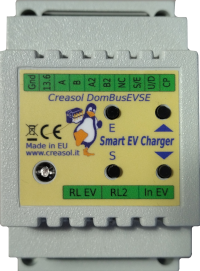
- Single-phase and three-phases, up to 32A (8kW or 22kW)
- Needs external contactor, RCCB (protection) and EV cable
- Optional power meter to measure charging power, energy, voltage and power factor
- Optional power meter to measure the power usage from the grid (not needed if already exists)
- Two max grid power thresholds can be programmed: for example, in Italy who have 6kW contractual power can drain from the grid Max (6* 1.27)=7.6kW for max 90 minutes followed by (6* 1.1)=6.6kW for another 90 minutes. The module can use ALL available power when programmed to charge at 100%.
- Works without the domotic controller (stand-alone mode), and can also work with charging current set by the domotic controller (managed mode)
Want to build a home-made, full features, EV charging station? Discover our KITs!
KIT for single phase wallbox
KIT for three phase wallbox
DomBusTH - Compact board to be placed on a blank cover, with temperature and humidity sensor and RGW LEDs
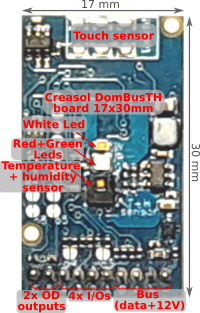
Includes:
- temperature and relative humidity sensor
- red, green and white LEDs
- 4 I/Os configurable as analog or digital inputs, pushbuttons, counters (water, gas, S0 energy, ...), NTC temperature and ultrasonic distance sensors
- 2 ports are configured by default as open-drain output and can drive up to 200mA led strip (with dimming function) or can be connected to the external module DomRelay2 to control 2 relays; they can also be configured as analog/digital inputs, pushbuttons and distance sensors.
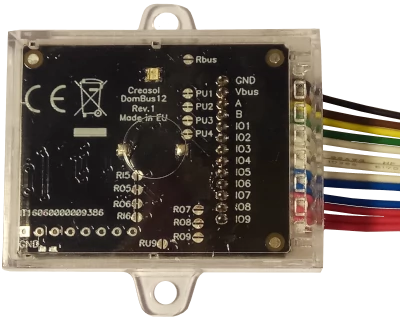
- analog/digital inputs
- pushbutton and UP/DOWN pushbutton
- counters (water, gas, S0 energy, ...)
- NTC temperature and ultrasonic distance sensors
- 2 ports are configured by default as open-drain output and can drive up to 200mA led strip (with dimming function) or can be connected to the external module DomRelay2 to control 2 relays.
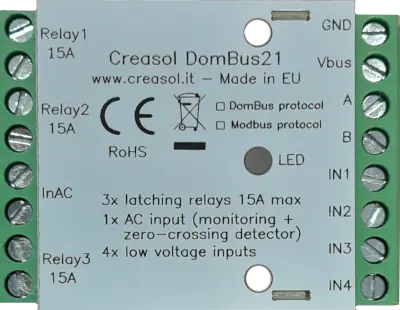
- 3x latching relays SPST, max current 15A (3kW): no power consumption when relays are On or Off!
- 1x 230V AC opto-isolated input to detect 230V and power outage, with zero-detection to switch relays/loads minimizing in-rush current
- 4x I/O lines, configurable as analog/digital inputs, temperature/distance sensor, counter, meter, ...
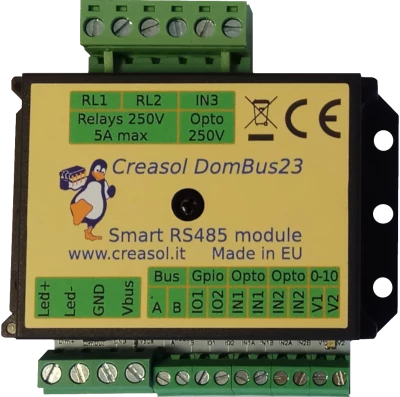
- 2x relays SPST 5A
- 1x 10A 30V mosfet (led stripe dimming)
- 2x 0-10V analog output: each one can be configured as open-drain output to control external relay
- 2x I/O lines, configurable as analog/digital inputs, temperature/distance sensor, counter, ...
- 2x low voltage AC/DC opto-isolated inputs, 9-40V
- 1x 230V AC opto-isolated input
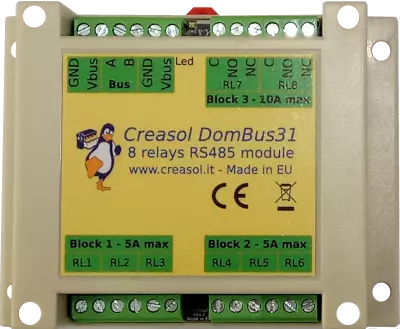
- 6x relays SPST 5A
- 2x relays STDT 10A
- Only 10mW power consumption with all relays OFF
- Only 500mW power consumption with all 8 relays ON !!
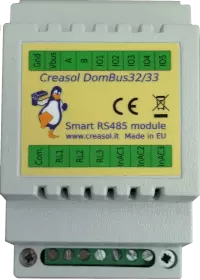
- 3x relays SPST 5A
- 3x 115/230Vac optoisolated inputs
- Single common for relays and AC inputs
- 5x general purpose I/O, each one configurable as analog/digital inputs, pushbutton, counter, temperature and distance sensor.
- 3x relays SPST 5A
- 3x 115/230Vac optoisolated inputs
- Single common for relays and AC inputs
- 5x general purpose I/O, each one configurable as analog/digital inputs, pushbutton, counter, temperature and distance sensor.
Each relay can toggle the existing step-relay, switching the light On/Off. The optoisolator monitors the light status. The 5 I/Os can be connected to pushbuttons to activate or deactivate one or all lights.
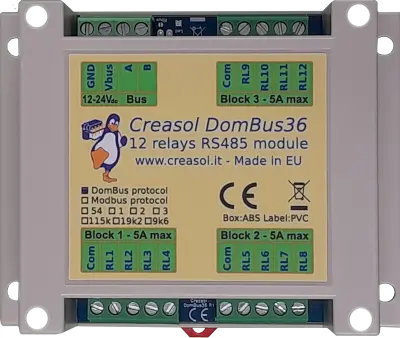
- 12x relays SPST 5A
- Relays are grouped in 3 blocks, with a single common per block, for easier wiring
- Only 12mW power consumption with all relays OFF
- Only 750mW power consumption with all 12 relays ON !!
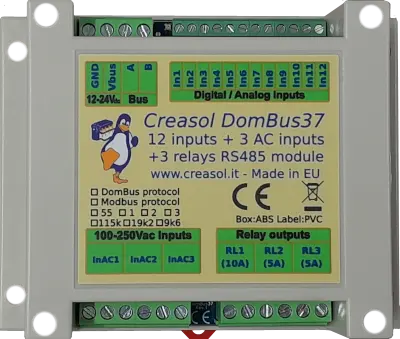
- 12x low voltage inputs (analog/digital inputs, buttons, alarm sensors, counters, temperature and distance sensors, ...)
- 3x 115/230Vac optoisolated inputs
- 2x relays SPST 5A
- 1x relay SPST 10A
- In12 port can be used to send power supply to an external siren, monitoring current consumption
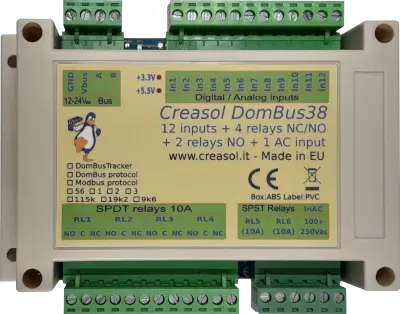
- 12x low voltage inputs (analog/digital inputs, buttons, alarm sensors, balanced double/triple biased alarm sensors, counters, meters, temperature and distance sensors, ...)
- 1x 115/230Vac optoisolated input to detect power outage and for zero-crossing detection (to switch relays minimizing the in-rush current)
- 4x relays SPDT 10A (with Normally Open and Normally Closed contacts)
- 2x relays SPST 10A (with only Normally Open contacts)
DomBusTracker - Dual axis sun tracker controller working with Domoticz, Home Assistant, Node-RED, Modbus, ... and also working in standalone with no external controllers
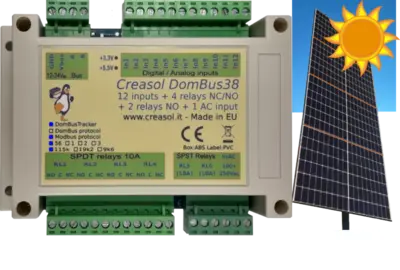
- Controls two external actuators/motors (linear or not) to move motors to reach the best tilt / elevation and azimuth position to optimize photovoltaic production.
- Check current through the motors to detect internal limit switch (useful for linear actuators) and find where the tracker reach the final/initial position.
- Works autonomously (stand-alone), without any home automation system controller, but also can be interface by Domoticz (DomBus protocol) and Home Assistant, NodeRED, OpenHAB, ... (using Modbus protocol).
- Wire connection (RS485) to the domotic controller for the best reliability.
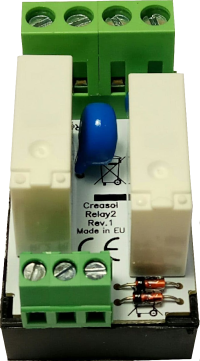
- 2x SPST relays 5A (Normally Open contact)
- Overvoltage protection (for inductive loads, like motors)
- Overcurrent protection (for capacitive laods, like AC/DC power supply, LED bulbs, ...)
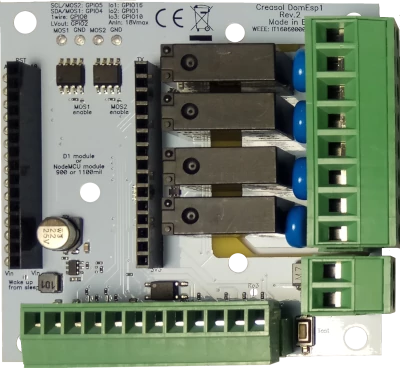
- 9÷24V power supply input, with high efficiency DC/DC regulator with 5V output
- 4x SPST relays 5A with overvoltage protection (varistor)
- 2x mosfet outputs (max 30V, 10A) for LED dimming or other DC loads
- 1x I²C interface for sensors, extended I/Os and more)
- 1x OneWire interface (DS18B20 or other 1wire sensors/devices)