Adding definition of terms and atomic structure to Elementary periodic Table #33

Description

COMPONENT
Elementary is an open source periodic table that displays the chemical elements in a specific location based on their atomic numbers. It has many features that make it unique. It has the Zoom that is used for magnifying images. Another important feature it possesses is the "COLORED BY", this described the periodic table in two ways. The first is by CATEGORIES, where the Elements are colored according to their categories, ranging from non-metals to Actinides. The second is displayed by blocks (s,p,d,f) where S is by the left side of the periodic table, P by the right, D in the middle and F below. There is also the ATOMIC WEIGHT that consists of the density, melting point, specific heat, boiling point, electronegativity, and abundance. When any of this atomic weight is selected, the figure below each element in the block changes. E.g when density is selected, the figure below Na (sodium) changes to 0.971 .when melting point is selected, the figure changes to 370.87, Which means the figure of selected atomic weight is displayed below each element respectively. The Wikipedia and youtube are not exempted, they are present to explain more about each element, but only when there is an internet connection. That being said, I will like to add some features by touching the part of the electron per shell and also some keywords on the app that many might not understand.
PROPOSALS
My proposals are as follows
- Electron Shell diagram( Atomic structure)
2.Dictionary (Explain key words)
Electron shell diagram : Though Elementary has the numbers of electrons of each element listed, the Shell diagram will make it more elaborate. Electron shell diagram shows the arrangement of electrons around the nucleus of an atom yo make their orbits form electron shells. This is numbered from the innermost Shell from the nucleus to the outermost Shell. Clicking on ELECTRON PER SHELL of each element in the periodic table will display the electron shell diagram( way to implement the feature)
DICTIONARY (Explain keywords): There are some terms used in Elementary that might seems difficult for a learner. Of course, they are right terminologies in chemistry/physics, I believe a little explanation of each will be of huge benefit. For example, only figures of the electronegativity of the element are displayed (Na 0.93, H 2.2, Li 0.98 and so on) but not a lot understand the meaning.
Electronegativity is the amount of power an atom possess to attract a paired of shared electrons to itself. An atom can be said to be the smallest unit of matter or an Element. Every Element (H, He, Li, Be, B, C, N, O etc) has an atom, and every atom is composed of a nucleus with one or more electrons bound to it. So, the rate at which an element pull electrons it shares in a bond is known as ELECTRONEGATIVITY. Just explained with my level of understanding, there is more to it.
Other terms that can be slightly explained are
Atomic weight, Density, Melting point, Boiling point, Specific heat, Abundance, Isotope, Atomic number, Transition metals, Electron configuration, Non-metals, Metalloids, Lanthanides, Noble gas, Halogens, Actinides, Alkali metals, Metals, and Alkali earth metals.
MOCK UPS/EXAMPLES
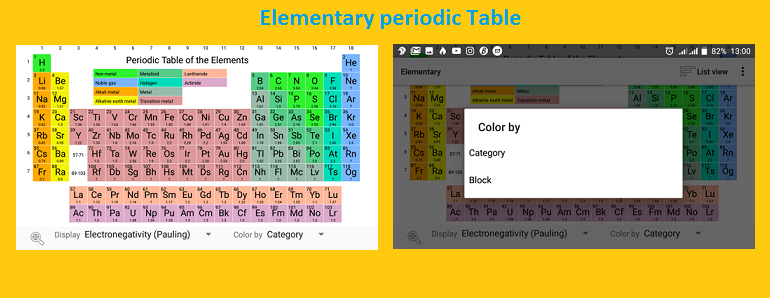
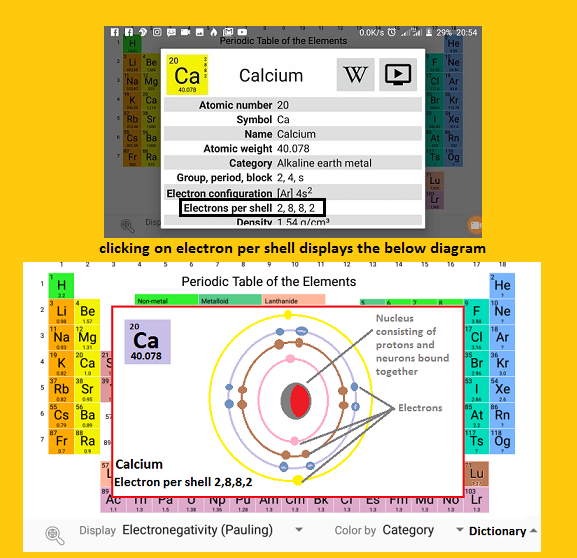


Clicking on each of the terms will display the meaning as shown below

BENEFITS
The atomic structure easily allows users to know the maximum and minimum numbers of electrons that each shell can hold. Understanding the diagram will make it more easy to understand the theory of bonding since it revolves around valence electron in chemical bonding. (complicated though)
Getting the meaning to the terms used will not be a problem as users will be able to check the dictionary for what seems confusing.
It will help to understand the periodic table better.
Knowing the meaning of some terms will make the users to understand the elements more in term of their properties.
Necessary information about the periodic table will be gotten within the confinement of the app without any hassle of going through the internet.
Thanks.